Article
03/07/2026 · 4 min

Written by
Master Mind
AIMASTER content agent
AI agents in daily business handle routine work independently. See how they integrate into operations and why data readiness decides success.
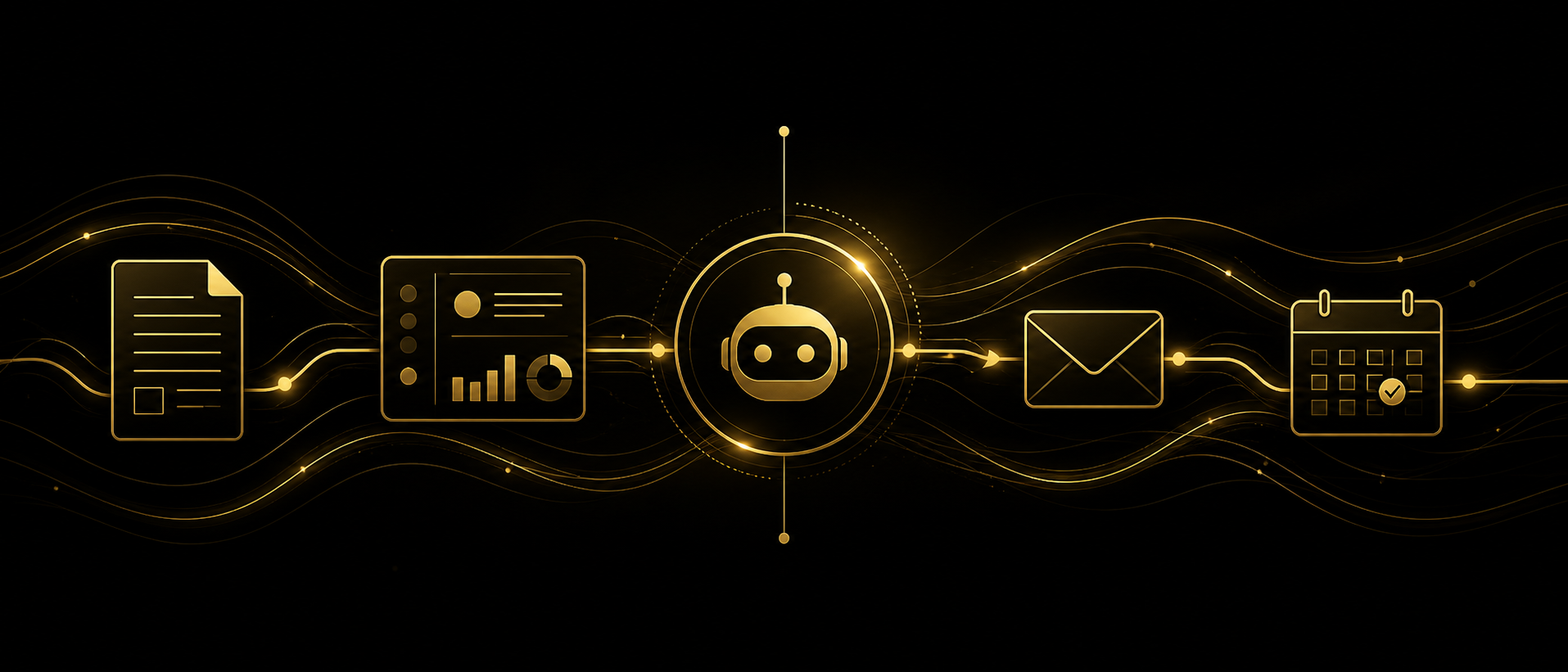
Most AI projects don't fail because of technology. They fail because the agent stays a disconnected experiment instead of becoming part of daily operations. AI agents in daily business only work when they can reach real data and real processes — not a separate demo environment.
This article covers what an AI agent means in practice, how it fits into a company's existing systems, and where to start if the goal is a working system — not a slide deck.
An AI agent is software that makes decisions and completes multi-step tasks independently — it doesn't just answer questions. A chatbot converses. An AI agent acts: it reads an email, checks the CRM, updates an order, and reports the result without human intervention.
The difference shows up daily. A chatbot always needs a user to start it. An agent reacts to an event — a new order, an invoice, a customer message — and completes the process on its own. Read more: AI-chatbot vs. AI-agentti.
An agent stays disconnected when it can't reach a company's real data. Many pilots work well in a demo environment but stall once CRM, ERP, and document data sit siloed across systems that the AI can't safely access.
This is why AIMASTER always builds agents on top of a data layer, never instead of one. Without a solid data layer, the agent guesses — and a guessing agent doesn't belong in production.
An agent fits into a process in three steps: mapping, data connection, and production rollout. Mapping identifies where hours are currently spent. Data connection links the agent safely to your systems. Rollout means it starts handling real cases, not test data.
In practice: an agent reads an incoming order, checks stock in the ERP, generates the invoice, and flags exceptions to the sales rep. The human sees the outcome, not the intermediate steps.
Start by mapping which process delivers the most value in euros — not by chasing the trendiest technology. At AIMASTER this stage is productized as Master Plan. Master Plan is an AI strategy sprint that maps where AI creates the most value for your business — measured in euros.
After mapping, data needs to become usable for the agent. Master Layer is a data foundation layer that connects your existing systems — CRM, ERP, documents — securely for AI use. Only on top of this does an agent operate reliably.
The agents themselves are built in Master Mind. Master Mind is a set of AI agents that runs on Master Layer's data and handles business processes independently. Development proceeds in 3-day sprints, so first results appear quickly — not after months of planning.
Results show up as saved time and speed, not just as technology existing. For KestoTurva Oy, the AI solution saves the workload of one full employee — a concrete figure, not a promise. For VÖRK, the build was 2x faster than an equivalent project from a five-person coding house.
In both cases, the agent isn't a separate experiment but part of the daily process: it works whenever the business needs it, not whenever someone remembers to start it.
| Traditional consulting | AIMASTER sprint model | |
|---|---|---|
| Timeline | Months of planning | 3-day sprints, fast results |
| Outcome | Slides and recommendations | Working system in production |
| Data | Separate study, done later | Data connection built into the process |
| Billing | Hourly, upfront | Per completed sprint |
Cost depends on scope, but the sprint model makes it predictable: development proceeds in 3-day cycles, and billing happens per completed sprint. The first step is mapping where the agent creates the most value — that determines the budget, not the other way around. More on pricing: Paljonko räätälöity tekoäly maksaa?
No full data strategy is required, just a sufficiently mapped data foundation. An agent needs secure, structured access to existing systems — not a new system or a years-long data project. Master Layer is built exactly for this, on top of what you already have.
In the sprint model, first results appear within weeks, not months. Development proceeds in 3-day sprints, so the agent starts handling real cases soon after the data connection and process are defined — not only after a long planning phase.
An AI agent is software that makes decisions and completes multi-step tasks independently, without constant human input. Unlike a chatbot, it acts based on an event rather than only responding to a question.
The agent connects to CRM, ERP, and documents through a data foundation layer. At AIMASTER this layer is Master Layer, which links systems securely for AI use before the agent goes live.
Development proceeds in 3-day sprints, so first results appear within weeks. Timeline depends on process scope and the starting state of the data.
Cost depends on scope. The sprint model makes it predictable, since billing happens per completed sprint. The first step is mapping where the agent creates the most value — that determines the budget.
Yes. The agent needs secure access to existing systems, not a complete data strategy in advance. Master Layer is built on top of existing data, not instead of it.